
By Harun Al-Rasyid Lubis. Professor of the Faculty of Civil and Environmental Engineering (FTSL) Bandung Institute of Technology (ITB), was once a member of the National Railway Revitalization Technical Team, and is currently active as Chairman of the Infrastructure Partnership & Knowledge Center (IPKC).
Indonesia’s most immediate constraint today is not a shortage of ideas. It is money—and, more precisely, budget discipline.
Fiscal space is narrowing just as the state vows to deliver everything, everywhere, all at once: free nutritious lunches, food estates and “Koperasi Merah Putih,” mass public housing, mineral downstreaming, big-ticket military procurement, the new capital city (IKN), and even a Jakarta–Surabaya high-speed rail.
These programs are not separate shopping items. They compete for the same scarce inputs: logistics capacity, energy supply, skilled workers, land, regulatory bandwidth, and political attention.
Each also carries liabilities that rarely make it into slogans—maintenance, land compensation, environmental remediation, and contingent guarantees.
Pursuing them all without hard prioritization has a predictable cost: eroded public services, stranded assets, higher borrowing, and ultimately a credibility gap that raises Indonesia’s risk premium.
In this context, “continuation” is not a policy. It is a fiscal fantasy.
Continuity, if it means anything, should mean choosing what to keep, improve, or stop—based on net public value under binding budget constraints.
Instead, what we see too often is a performance of inevitability: intellectual authority mobilized to bless a maximalist agenda while the ledger deteriorates.
The Missing Protagonist
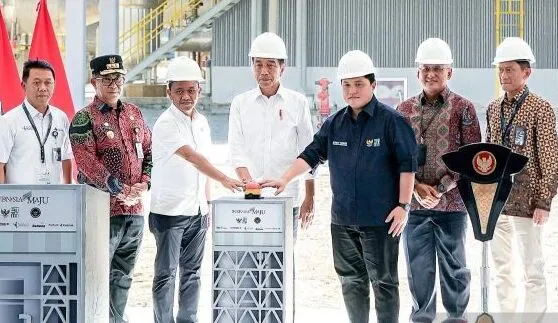
Jokowi’s decade delivered visible infrastructure, targeted assistance, and a more assertive industrial policy. But the bill is now arriving: maintenance obligations, land and environmental liabilities, and contingent exposures that shadow megaprojects.
Pretending the next administration can simply stack new, expensive promises on top of old commitments—without triage—is how countries drift toward austerity, or toward inflationary shortcuts.
The missing protagonist in this story is opportunity cost. Every rupiah has an alternative use. And in tight times, the alternative is usually more valuable than the headline.
Every rupiah poured into a coal-powered smelter ecosystem that locks in emissions is a rupiah not spent on resilient feeder roads, ports, and grid upgrades that support diversified growth.
Every housing block built far from jobs is foregone investment in transit-oriented infill that lowers household transport burdens.
Every prestige weapons purchase not aligned with standardized fleets is money unavailable for readiness, training, maintenance—the real currency of security.
When budgets tighten, sloppy continuity becomes cannibalization: new programs consume the capacity of old ones, and then neither works.
Take the free nutritious lunch program as example. If it is done right, it can improve health and learning outcomes. But done poorly, it becomes a national-scale waste machine.
Keep the Idea but with Discipline
A nationwide rollout without disciplined piloting invites predictable failure: spoilage, price spikes in local markets, capture by a small circle of caterers, and procurement leakage.
The responsible path is not to abandon the idea—but to treat it like a public investment that must earn its scale. Pilot across diverse districts. Publish cost-per-child and nutrition outcomes. Integrate growth monitoring and deworming.
Use open e-procurement with random inspections. Scale only when unit costs, logistics performance, and impact are proven.
Otherwise, the opportunity cost is real—textbooks, teacher training, primary healthcare inputs—often deliver higher returns per rupiah.
Food estates and Koperasi Merah Putih are also wrapped in the language of self-reliance, but they routinely collide with agro-ecological constraints and governance reality.
Opening peatlands or frontier areas requires serious hydrology management, drainage control, soil science, and fire-risk systems. Skipping those steps does not just reduce yields; it creates liabilities.
Meanwhile, cooperatives without capital discipline and audited governance can become political conduits for subsidies, not engines of productivity.
The technocratic alternative is boring—but effective: raise yields on existing smallholder plots with extension services, inputs, and irrigation repair; enforce cooperative transparency and dividend rules; publish dashboards tracking yields, water tables, and deforestation.
The opportunity cost of chasing greenfield acreage is neglecting millions of hectares where modest improvements would compound across the country.
Public Housing Risks

Public housing risks repeating an old pattern: unit targets beating job access. Building where land is cheap may look efficient on paper, but it often produces ghost blocks and lifetime maintenance bills.
Fiscal responsibility requires demand-first planning, job-access metrics, brownfield infill near transport, lifecycle costing that actually provisions operations and maintenance, and transparent Tapera governance with credible opt-outs and annual performance reports.
Every distant housing block is opportunity cost against upgrading kampung infrastructure, fixing water networks, and funding reliable buses—investments that raise welfare now, not someday.
Downstreaming, meanwhile, is framed as destiny. But destiny is not a business plan. The real math must include energy intensity, remediation, commodity price cycles, and the hard truth about technology transfer.
Export bans can catalyze investment; they can also create carbon-heavy enclaves that privatize gains while socializing environmental debts.
Under fiscal limits, downstreaming must be defended project by project: cost-benefit analysis that includes carbon pricing; remediation bonds with enforcement teeth; incentives tied to real local content and skills milestones; and credible grid decarbonization plans.
Otherwise, opportunity cost bites again: the country misses productivity-enhancing investments—skills, research and development (R&D), small medium enterprises (SMEs) upgrading—that build breadth beyond commodities.
On Military Procurement
 Military procurement is another arena where prestige can quietly defeat readiness. Mixed fleets inflate total ownership costs and depress availability.
Fiscal prudence means capability-based planning, platform standardization, 15–20-year lifecycle costing, and published offset deliverables that create measurable local capability.
The opportunity cost of shopping lists is hollow force structure: impressive on paper, rarely operational. Then, we reach the loudest continuity claims—and the largest risks: IKN and the proposed Jakarta–Surabaya high-speed rail.
These megaprojects intersect with every constraint at once: land, ecology, energy, fiscal guarantees, and public trust. In a funding-tight reality, risk mitigation is not optional. It is the price of admission.
For IKN, credibility requires more than ceremonies and renderings. It demands hard rules:
Phase only with verified demand: no advance without occupancy and service benchmarks.
Ring-fence O&M budgets to prevent decay, and disclose contingent liabilities clearly.
Transparent land governance to prevent speculative capture and ensure fair compensation.
Water, biodiversity, and peat/hydrology management with independent monitoring and enforceable penalties.
Clear stop rules: if uptake lags, costs breach thresholds, or ecological indicators deteriorate, pause or resize.
Without these, IKN risks becoming a fiscal sink—crowding out nationwide upgrades to schools, clinics, and urban infrastructure that touch far more lives per rupiah.
Risk Mitigation of High Speed Rail Project

For Jakarta–Surabaya high-speed rail, risk mitigation must start with humility about demand and cost:
Independent demand forecasting, stress-tested against fares, competing modes, and macro shifts—and publish the models.
A fair comparison with incremental upgrades (double-tracking, signaling, semi-HST), using transparent cost-benefit and distributional impacts.
A corridor densification strategy so stations anchor real, taxable economic activity—not vanity terminals.
Financing that caps sovereign exposure, hedges currency risk, and uses performance-based contracts with published terms and penalties.
Conservative farebox and non-fare revenue scenarios, not optimistic fantasies.
Without that discipline, the line may deliver speed—at the opportunity cost of starving national rail and bus networks that carry the many, not the few. All of this leads to a simple governance test under fiscal scarcity: audit culture or applause culture.
If we keep launching nationwide programs without pilots, bypassing line ministries through ad hoc task forces, compressing procurement in ways that reduce competition, and celebrating key performance index (KPI) that count inputs rather than outcomes, we will pay twice—first in overruns, then in lost alternatives.
The “continuation” costume hides real shifts in fiscal risk and institutional roles. It is not continuity. It is drift dressed as destiny. A better path is disciplined prioritization:
Publish theories of change, unit costs, baselines, and evaluation timelines for every flagship program.
Pilot, evaluate, scale—and sunset what fails. Budget against outcomes, not outputs.
Open contracts, supplier lists, and environmental liabilities; enforce remediation bonds.
Strengthen local government execution capacity and align incentives to measurable results.
Build citizen dashboards and protect whistleblowers to keep programs honest.
Continuity should be treated as a hypothesis—tested against budgets and evidence. Keep building, but within ecological ceilings and social floors. Keep downstreaming, but with clean power, transparent contracts, and workforce upgrading.
Keep social protection, but with fiscal realism and labor-market reforms. Keep courting investment, but with standards that raise the quality of growth. In tight times, saying “no” is not disloyalty. It is stewardship.
Read also: Where does the City of Banjarmasin Go in the Future?
Budgets don’t reflect the programs. When intellectual authority performs inevitability instead of forcing hard questions about trade-offs, the result is not just absurd—it is expensive.
Indonesia deserves a development debate that puts opportunity cost at the center and treats public money as the scarce resource it is.
Otherwise, the promise of seamless continuation will end where unchecked agendas always do: crowded balance sheets, stranded promises, and a politics of disappointment.
When it comes to anti-corruption, the show is like Bollywood movies. Showing off looted money to the public is only suitable for those who don't understand, but it quickly becomes boring and hinders the business from progressing.***
Check out the latest public policies and geopolitic news on our Whatsapp and Telegram channels.